Showing posts with label Information. Show all posts

Saturday, 18 March 2023

Protection From Other People With Guns


The information analysis is based on the tonic falling on have and legally in the first clause, and on majority and protect in the clause complex.

Saturday, 28 May 2022

The Materiality Of Birth

Once upon a time, there was a girl and the girl had a shadow. The two were connected, tethered together. And the girl ate, her food was given to her warm and tasty. But when the shadow was hungry, he had to eat rabbit raw and bloody. On Christmas, the girl received wonderful toys; soft and cushy. But the shadow's toys were so sharp and cold they sliced through her fingers when she tried to play with them. The girl met a handsome prince and fell in love. But the shadow at that same time had Abraham, it didn't matter if she loved him or not. He was tethered to the girl's prince after all. Then the girl had her first child, a beautiful baby girl. But the shadow, she gave birth to a little monster. Umbrae was born laughing. The girl had a second child, a boy this time. They had to cut her open and take him from her belly. The shadow had to do it all herself. She named him Pluto, he was born to love fire. So you see, the shadow hated the girl so much for so long until one day the shadow realised she was being tested by God.


Reasoning:

1. In the first clause, the question is whether a beautiful baby girl is a depictive Attribute or a unit in a nominal group complex. Viewed 'from above', both interpretations construe an elaborating relation between her first child and a beautiful baby girl. However, viewed 'from below', a beautiful baby girl is realised by its own tone group, with the same tone choice as the preceding tone group (tone concord). This is a feature of paratactic elaboration (apposition), but not of depictive Attributes.

2. In the second clause, the question is how to analyse the shadow. In this instance, there is no possible tone concord with she, so the two do not form an elaborating paratactic nominal group complex, and so the shadow is a distinct clause element. The clue here is textual. Whatever its experiential function, the shadow is realised by its own tone group, making it the focus of New information, switching the focus of attention from the girl. Similarly, if the shadow is a distinct clause element, then it must function as marked Theme, since the Subject/Actor is she. The simplest explanation comes from taking the view 'from roundabout' and interpreting the shadow as agnate to such Matter circumstances as regarding the shadow, as for the shadow etc.

3. In the third clause, the question is whether open is the particle of a phrasal verb or a resultative Attribute. Viewed 'from above', both interpretations construe open as the result of cut, and viewed 'from roundabout', both interpretations have the same modal structure, since the particle of a phrasal verb and a resultative Attribute both serve as Adjunct. In this instance, the view 'from below', however, favours a resultative Attribute interpretation, since the particle of a phrasal verb is either a preposition or an adverb (Halliday & Matthiessen 2014: 413), whereas open is an adjective, which is a typical realisation of a resultative Attribute.

Friday, 6 August 2021

A More Distressing Attribute


The motivation for the discontinuous Attribute is textual: to highlight the demonstrative reference item (that), in the comparison made by the Qualifier, as the unmarked New.

Friday, 19 February 2021

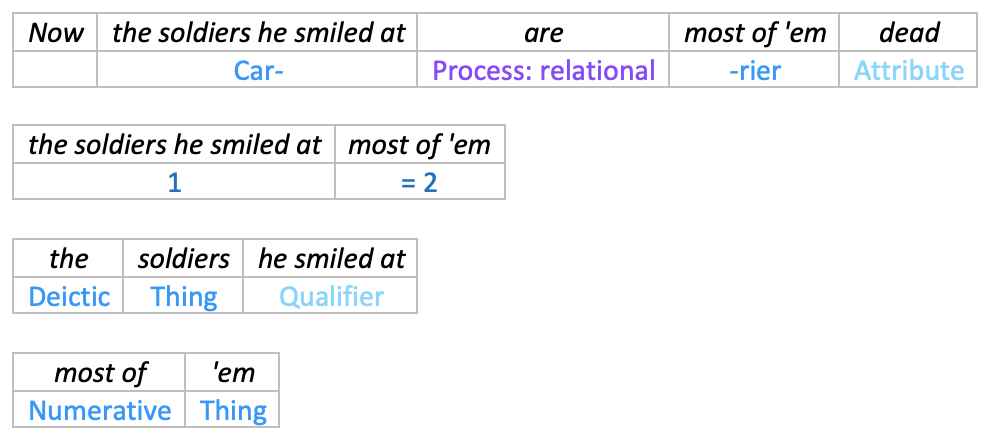
Discontinuous Nominal Group Complex (The Soldiers He Smiled At … Most Of 'Em)

“Good morning, good morning!” the General said
When we met him last week on our way to the line.
Now the soldiers he smiled at are most of 'em dead,
And we're cursing his staff for incompetent swine.
“He's a cheery old card,” grunted Harry to Jack
As they slogged up to Arras with rifle and pack.
But he did for them both by his plan of attack.


The nominal group most of 'em elaborates the the nominal group the soldiers he smiled at by clarifying it. The interdependency relation is paratactic, because either nominal group can serve as Carrier in its own right.

Again, the motivation is textual, not just in conforming to the rhythm of the poem, but because the elaborating nominal group in this position forms a single information unit, with most as the focus of New. But this has the added effect of making dead the focus of New in a following one-word information unit. In this way the poet makes his point by giving maximum textual prominence to both most and dead, together with the previous focus smiled at within the Theme.


// 1 ‸ Now the / soldiers he / smiled at are // 1 most of them // 1 dead //

Discontinuous Nominal Group (Woman … With Stab Wounds)

The motivation for displacing the Qualifier in this news story headline is textual: to make it the unmarked focus of New information, so that the Phenomenon/Subject is assigned two peaks of textual prominence: Theme and New.

Note also that the clause has no Finite or Medium through whom the Process is actualised.

Saturday, 15 June 2019

Theme Vs Information


Where did you put it?

I
put
it
in the cupboard
Theme
Rheme
Given
New


Who put this in the cupboard?

I
did
Theme
Rheme
New: marked


Halliday & Matthiessen (2014: 120):
But although they are related, Given + New and Theme + Rheme are not the same thing. The Theme is what I, the speaker, choose to take as my point of departure. The Given is what you, the listener, already know about or have accessible to you. Theme + Rheme is speaker-oriented, while Given + New is listener-oriented. 
But both are, of course, speaker-selected. It is the speaker who assigns both structures, mapping one on to the other to give a composite texture to the discourse and thereby relate it to its environment.

Friday, 24 May 2019

Revealing The ‘Slow Reveal'


  1. Something moved inside.
  2. Two dark eyes stared out at him.
  3. He snatched a frightened glimpse of a man’s face. Staring. Watching….

1. The first clause construes a happening, but the Thing realising the Medium of the Process is not differentiated for [± conscious], let alone [± human].

Something
moved
inside
Actor
Process: material
Location: relative: rest

2. The second clause construes a conscious process as a behaviour, thereby assigning [+conscious] to the Medium of the Process, but not resolving the question of [± human]. This ambiguity is reinforced by the use of synecdoche — realising the Behaver in terms of its parts (two dark eyes) — and by the lexical choice of dark, which potentially signals both the unknown, and a negative assessment ('sinister') of the conscious Behaver.

Two dark eyes
stared
out
at him
Behaver
Process: behavioural
Location: relative: motion: away from
Location: orientation
marked focus of New


The potential threat of a 'dark' consciousness is then supported the lexical choice of Process, stare, which also provides the Quality of the Process ('look fixedly'), and grammatically by the 'emanating' directionality given to the Process by the 'motion' and 'orientation' Locations.

3. The third clause metaphorically construes a 'middle' mental clause as an 'effective' material clause.

Senser
Process:
Manner: quality
mental: perception
Phenomenon
He
snatched
a
frightened
glimpse of
a man’s face
Actor
Process: material
Goal


focus of New

Because the wording of a metaphorical clause additionally realises the meaning of its congruent agnate, this simultaneously construes both the outer (material) experience and the inner (mental) experience of the protagonist.

Less abstractly, in terms of outer experience, the clause construes the protagonist as taking quick action — with the lexical choice of Process, snatch, also providing the Quality of the Process ('quickly seize'). On the face of it, this is self-directed action in response to the potential threat implied in the second clause.

Only more abstractly does the clause construe the inner experience of the protagonist: as perceiving a Phenomenon — now confirmed as apparently [+ human], through synecdoche (a man's face) — in an emotional manner (frightened).

The final two behavioural clauses put the information Focus on processes, but nevertheless keep material action frozen, by first repeating the potential threat staring ('look fixedly'), but then reducing the threat through the lexical choice of watching.

Staring
Process: behavioural
focus of New

Watching
Process: behavioural
focus of New