
Showing posts with label Logico-Semantic Relations. Show all posts
Showing posts with label Logico-Semantic Relations. Show all posts
Wednesday, 9 July 2025


Tuesday, 18 March 2025
Clause Complex Embedded As Qualifier Of Epithet

Cf I'm not very surprised…
Halliday & Matthiessen (2014: 275):
Submodifiers like so, very, too go with nominal groups but not with verbal groups: we can say I was very afraid of it but not I very feared it; you’re not too keen on it but not you don’t too want it.
Monday, 1 July 2024

Sunday, 28 April 2024

Saturday, 13 April 2024
Nominal Group Qualifiers?
Beatriz Quiroz asked on Sysfling on 12 Apr at 5:24:
How would you analyse the underlined element in the following English nominal groups:The year 1920Would they all be Qualifiers?
My friend John
captain Ahab
his wife Sarah
The city of Rome
Just the first and last.

But, even in IFG4 (p391):
Other than this type [nominal group as Attribute], Epithets and Classifiers do not normally function as Head.
Thursday, 22 February 2024
The Days Of Auld Lang Syne

Both units of the Qualifier realise the meaning 'in the past', with the second elaborating the first, and the relation is paratactic, because neither depends on the other:
The days of auld (old)
The days lang syne (long since/long ago)
However, on the model of Halliday (1994: 193):
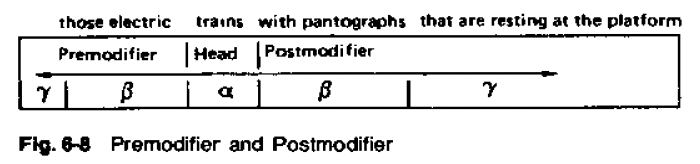
the logical structure is:

Monday, 16 October 2023
Tilting Towards Grammatical Metaphor


The instances above demonstrate a developmental path toward mastering grammatical metaphor. The Year 7 student has produced a congruent realisation of a sequence, a clause complex, but moved towards the grammatical metaphor of adult language by using an anaphoric reference item (that) as Token of the primary clause. The next step is to replace the reference item with the referent, thereby creating a metaphorical clause simplex in which an act is decoded by reference to a fact:

The verb mean can serve as the 'sign' subtype of intensive identifying process, like indicate, suggest, imply, show, betoken, mark, reflect, or as the 'symbol' subtype, like express, signify, realise, spell, stand for (Halliday & Matthiessen 2014: 269). Here it serves as as the 'sign' subtype.
Thursday, 27 July 2023

Saturday, 27 November 2021

Sunday, 21 November 2021
Thematic Equative In Complex With Nested Dependent Clause

This identity encodes the Value what we can notice by reference to the Token a clear evolutionary tendency towards centralisation.
Monday, 23 August 2021


Wednesday, 18 August 2021

Sunday, 8 August 2021

Thursday, 5 August 2021
With An Extending Attributive Clause Complex Looking Like A Circumstance

Halliday & Matthiessen (2014: 476):
With the additive, the Process of a relational dependent clause may be implicit; the marker is the conjunctive preposition with (positive) or without (negative):||| I told the whole story of the six-minute Louvre at The Kennedy Center || with President Carter there …|||||| Without chlorine in the antarctic stratosphere, || there would be no ozone hole. |||
Tuesday, 3 August 2021


Tuesday, 6 July 2021
A Serpent Verbally Projecting A Proposal


cf

According to Joseph Campbell, in most mythologies, the serpent is a symbol of rebirth — and so of creation — since 'it sheds its skin to be born again'.
Such mythic symbolism uses lexical metaphor to make the deep epistemological observation that human 'reality' is a linguistic creation: a construal of experience as meaning.
Friday, 19 February 2021
Discontinuous Nominal Group Complex (The Soldiers He Smiled At … Most Of 'Em)
“Good morning, good morning!” the General said
When we met him last week on our way to the line.
Now the soldiers he smiled at are most of 'em dead,
And we're cursing his staff for incompetent swine.
“He's a cheery old card,” grunted Harry to Jack
As they slogged up to Arras with rifle and pack.
But he did for them both by his plan of attack.
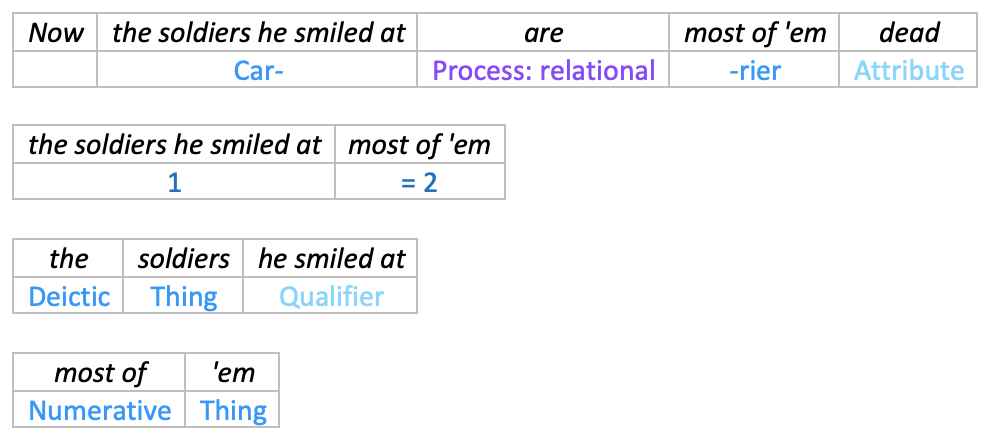
The nominal group most of 'em elaborates the the nominal group the soldiers he smiled at by clarifying it. The interdependency relation is paratactic, because either nominal group can serve as Carrier in its own right.
Again, the motivation is textual, not just in conforming to the rhythm of the poem, but because the elaborating nominal group in this position forms a single information unit, with most as the focus of New. But this has the added effect of making dead the focus of New in a following one-word information unit. In this way the poet makes his point by giving maximum textual prominence to both most and dead, together with the previous focus smiled at within the Theme.

// 1 ‸ Now the / soldiers he / smiled at are // 1 most of them // 1 dead //
Thursday, 28 January 2021
Borderline Cases Between Identifying And Verbal Processes: Indeterminacy
The difference between an identifying clause and a verbal clause is that an identifying clause construes a relation of identity between participants, whereas a verbal clause construes a 'signal source' that projects a locution (wording) into semiotic existence. An identifying clause construes different levels of symbolic abstraction, Token and Value, whereas a verbal nexus construes different orders of experience, projecting (first-order) and projected (second-order). Often verb substitution — e.g. 'is' for identifying, 'say' for verbal — can differentiate the types, but there are still instances of indeterminacy, e.g.

Friday, 16 November 2018
Particularising Clarifying Elaborating Conjunctive Adjunct
in particular
|
when
|
committed
|
as part of a plan or policy or as part of
a large-scale commission of such crimes
|
||
conjunctive Adjunct
|
Predicator
|
circumstantial
Adjunct
|
How do we know that in particular doesn't modify when?
Because, like a conjunctive Adjunct, it can occur at different points in the clause:
- when, in particular, committed as part of a plan or policy or as part of a large-scale commission of such crimes
- when committed, in particular, as part of a plan or policy or as part of a large-scale commission of such crimes
- when committed as part of a plan or policy or as part of a large-scale commission of such crimes, in particular
Sunday, 11 November 2018
Grammatically Intricate Clause Complex
Third, the crisis [in the European and the
global economy] has entered a second phase
|
characterised by a recovery
|
that is proceeding at a faltering pace
|
and is uneven across countries
|
α
|
= β
|
||
α
|
= β
|
||
1
|
+ 2
|
||
without unpacking the metaphor:
Third
|
the crisis [in the European and the global
economy]
|
has entered
|
a second phase
|
Actor
|
Process: material
|
Scope: process
|
characterised
|
by a recovery
|
Process: relational
|
Identifier Token
|
that
|
is proceeding
|
at a faltering pace
|
Actor
|
Process: material
|
Manner: quality
|
and
|
is
|
uneven
|
across countries
|
Process: relational
|
Attribute
|
Location
|
Subscribe to:
Posts (Atom)