Friday, 25 August 2023

The Butter Betty Bought

// 1 Betty / Botter / bought some / butter; //

// 1 “But,” said / she, “this / butter’s / bitter! //

// 4 If I / put it / in my / batter //

// 1 It will / make my / batter / bitter. //

// 3 But a / bit o’ / better / butter //

// 1 Will / make my / batter / better.” //

// 13 Then she / bought a / bit o’ / butter

/ Better / than the / bitter / butter, //

// 1 Made her / bitter / batter / better. //

// 1 So ’twas / better / Betty / Botter

/ Bought a / bit o’ / better / butter. //

Wednesday, 5 July 2023

Breathing Light


Francis Bacon's original words in 'Of Truth' were actually:
First he breathed light upon the face of the matter or chaos; then he breathed light into the face of man;

It is a pleasure to stand upon the shore, and see the ships tossed upon the sea;

Wednesday, 10 May 2023

Saturday, 18 March 2023

Protection From Other People With Guns


The information analysis is based on the tonic falling on have and legally in the first clause, and on majority and protect in the clause complex.

Monday, 6 February 2023

Predicated Theme vs Postposed Subject


Note that both clauses have the same interpersonal structure, though the Subject is realised by a nominal group in the predicated Theme clause, but by an elaborating paratactic nominal group complex in the postposed Subject clause.

Note also that the predicated Theme clause is encoding (the Value is encoded by reference to the Token your good luck), whereas the postposed Subject clause is decoding (the Token is decoded by reference to the Value your good luck).

Saturday, 14 January 2023

Giving A False Impression


This is not a material clause, as shown by the unmarked present tense: gives, not is giving.

Wednesday, 26 October 2022

Probability Realised By Both Finite Modal Operator And Noun Of Modalisation


There are thus 2 probabilities:
  1. the probability of complications or adverse effects (➘ noun of modalisation);
  2. the probability of increasing that probability (➘ Finite).
For nouns of modalisation, see Halliday & Matthiessen (2014: 536).

Friday, 15 July 2022

'Dare' As Finite vs Event


The unmarked Mood tag of the first clause is dare they?
The unmarked Mood tag of the second clause is would they?

See Halliday & Matthiessen (2014: 574): 'risk doing', 'venture to do'.

Saturday, 28 May 2022

The Materiality Of Birth

Once upon a time, there was a girl and the girl had a shadow. The two were connected, tethered together. And the girl ate, her food was given to her warm and tasty. But when the shadow was hungry, he had to eat rabbit raw and bloody. On Christmas, the girl received wonderful toys; soft and cushy. But the shadow's toys were so sharp and cold they sliced through her fingers when she tried to play with them. The girl met a handsome prince and fell in love. But the shadow at that same time had Abraham, it didn't matter if she loved him or not. He was tethered to the girl's prince after all. Then the girl had her first child, a beautiful baby girl. But the shadow, she gave birth to a little monster. Umbrae was born laughing. The girl had a second child, a boy this time. They had to cut her open and take him from her belly. The shadow had to do it all herself. She named him Pluto, he was born to love fire. So you see, the shadow hated the girl so much for so long until one day the shadow realised she was being tested by God.


Reasoning:

1. In the first clause, the question is whether a beautiful baby girl is a depictive Attribute or a unit in a nominal group complex. Viewed 'from above', both interpretations construe an elaborating relation between her first child and a beautiful baby girl. However, viewed 'from below', a beautiful baby girl is realised by its own tone group, with the same tone choice as the preceding tone group (tone concord). This is a feature of paratactic elaboration (apposition), but not of depictive Attributes.

2. In the second clause, the question is how to analyse the shadow. In this instance, there is no possible tone concord with she, so the two do not form an elaborating paratactic nominal group complex, and so the shadow is a distinct clause element. The clue here is textual. Whatever its experiential function, the shadow is realised by its own tone group, making it the focus of New information, switching the focus of attention from the girl. Similarly, if the shadow is a distinct clause element, then it must function as marked Theme, since the Subject/Actor is she. The simplest explanation comes from taking the view 'from roundabout' and interpreting the shadow as agnate to such Matter circumstances as regarding the shadow, as for the shadow etc.

3. In the third clause, the question is whether open is the particle of a phrasal verb or a resultative Attribute. Viewed 'from above', both interpretations construe open as the result of cut, and viewed 'from roundabout', both interpretations have the same modal structure, since the particle of a phrasal verb and a resultative Attribute both serve as Adjunct. In this instance, the view 'from below', however, favours a resultative Attribute interpretation, since the particle of a phrasal verb is either a preposition or an adverb (Halliday & Matthiessen 2014: 413), whereas open is an adjective, which is a typical realisation of a resultative Attribute.

Sunday, 6 March 2022

Making A Good Wife


i.e.
Sue constructed a good wife for Mary.
Sue was a good wife for Mary.
Sue turned Mary into a good wife.

Thursday, 3 March 2022

Identifying A Happy Baby With A Happy Mother


In the first clause, the lexical choice of thrive adds a quality 'well' or 'vigorously' to the Process, and the circumstance on Glaxo answers the Manner: means interrogative 'what with?' (Halliday & Matthiessen (2014: 318).

The second (reversible) clause identifies a happy baby with a happy mother; it does not construe a happy baby as member of the class a happy mother.*

The third clause assigns the membership of you to the class a happy mother.


* Cf. an attributive agnate which construes a mother as a member of the class happy:


Sunday, 21 November 2021

Thematic Equative In Complex With Nested Dependent Clause


This identity encodes the Value what we can notice by reference to the Token a clear evolutionary tendency towards centralisation.

Saturday, 20 November 2021

Thematic Equatives

 
See Halliday & Matthiessen (2014: 93-6).

One reason why the nominalisation in a thematic equative always serves as the Value participant is that an identifying clause relates a lower level of abstraction, Token, to a higher higher level of abstraction, Value, and the meaning realised by a nominalisation is, ceteris paribus, of a relatively higher level of abstraction than the meaning realised by a non-nominalisation.

Thursday, 23 September 2021

'Forget' As Material Process

In the following clause, 'forget' serves the same function as the verbal group complex 'forget to bring', and so serves as a material Process:


Halliday & Matthiessen (2014: 568):
It is the secondary group, or last secondary group if there is more than one, that realises the process type of the clause…

Friday, 6 August 2021

A More Distressing Attribute


The motivation for the discontinuous Attribute is textual: to highlight the demonstrative reference item (that), in the comparison made by the Qualifier, as the unmarked New.

Thursday, 5 August 2021

With An Extending Attributive Clause Complex Looking Like A Circumstance


Halliday & Matthiessen (2014: 476):
With the additive, the Process of a relational dependent clause may be implicit; the marker is the conjunctive preposition with (positive) or without (negative):
||| I told the whole story of the six-minute Louvre at The Kennedy Center || with President Carter there …|||

||| Without chlorine in the antarctic stratosphere, || there would be no ozone hole. |||  

Tuesday, 6 July 2021

A Serpent Verbally Projecting A Proposal


 cf


According to Joseph Campbell, in most mythologies, the serpent is a symbol of rebirth — and so of creation — since 'it sheds its skin to be born again'.

Such mythic symbolism uses lexical metaphor to make the deep epistemological observation that human 'reality' is a linguistic creation: a construal of experience as meaning.

Thursday, 6 May 2021

(The) Glaxo Exhibit: Theme, Transitivity & Mood


hypotactic extending verbal group complex of conation:


Here not is interpreted as a formal or written variant of the Finite negative element n't, rather than a distinct modal Adjunct, on the basis that the unmarked Mood tag would be should she? rather than shouldn't she?. See Halliday & Matthiessen (2014: 175-6).

The lexical choice of see adds a 'mental' feature to the material Process.

The additional participant rôle of Behaver is explained by Halliday & Matthiessen (2014: 576, 577):
The extending complex is a two-part process, in which the Subject fills a dual participant role: Behaver (in the conative component) plus Actor, or some other role, in the happening itself.

Saturday, 10 April 2021

'Autorise' & 'Permettre'

Cette démarche autorise l'agence à les rayer de ses listes.
This approach authorises the agency to delete them from its lists.

Pour permettre à ces demandeurs d'emploi seniors de subsister jusqu'à leur retraite, plusieurs types d'allocation sont prévus.
To enable these senior job seekers to survive until their retirement, several types of allowance are provided.

In English, these are the primary verbal groups of hypotactic enhancing causative (modulation) verbal group complexes. See Halliday & Matthiessen (2014: 580, 582-4).


In hypotactic verbal group complexes, it is the (last) secondary verbal group that realises the PROCESS TYPEHalliday & Matthiessen (2014: 568):
It is the secondary group, or last secondary group if there is more than one, that realises the process type of the clause, e.g. [material:] she seemed to mend it, [behavioural:] she seemed to laugh, [mental:] she seemed to like him, [verbal:] she seemed to tell us, [relational:] she seemed to be nice.
So, in these instances, both authorises to delete and enable to survive are material Processes. Although survive means 'continue to exist', unlike existential Processes, but like material Processes, it takes a Range participant, Scope, as in they survived the ordeal, and its unmarked present tense is the present in present, not the simple present.

Friday, 19 February 2021

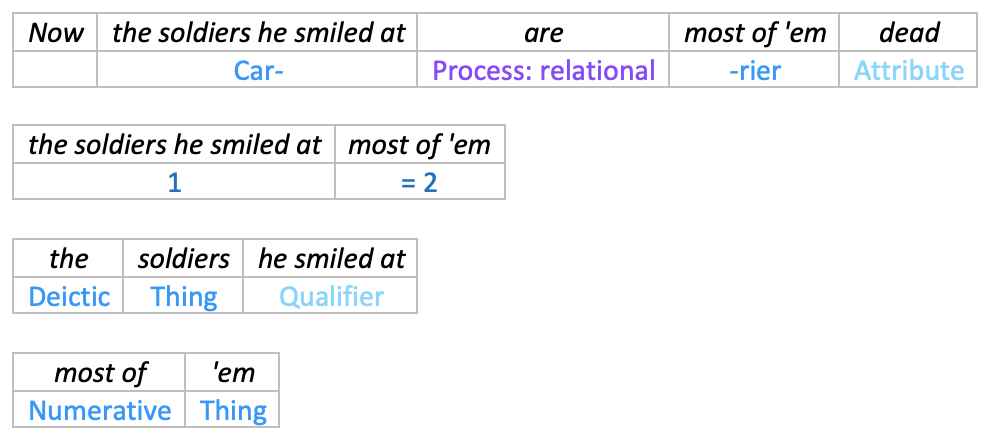
Discontinuous Nominal Group Complex (The Soldiers He Smiled At … Most Of 'Em)

“Good morning, good morning!” the General said
When we met him last week on our way to the line.
Now the soldiers he smiled at are most of 'em dead,
And we're cursing his staff for incompetent swine.
“He's a cheery old card,” grunted Harry to Jack
As they slogged up to Arras with rifle and pack.
But he did for them both by his plan of attack.


The nominal group most of 'em elaborates the the nominal group the soldiers he smiled at by clarifying it. The interdependency relation is paratactic, because either nominal group can serve as Carrier in its own right.

Again, the motivation is textual, not just in conforming to the rhythm of the poem, but because the elaborating nominal group in this position forms a single information unit, with most as the focus of New. But this has the added effect of making dead the focus of New in a following one-word information unit. In this way the poet makes his point by giving maximum textual prominence to both most and dead, together with the previous focus smiled at within the Theme.


// 1 ‸ Now the / soldiers he / smiled at are // 1 most of them // 1 dead //